
Chapter 5: Your Cardiologist Probably Hasn't Heard of This Heart-Healing Therapy—But the Research Is Piling Up
New evidence suggests ozone therapy may improve heart function, reduce damage after heart attacks, and give heart failure patients their lives back

A 58-year-old executive sits in my office, frustrated. He’s done everything right—the statins, the beta-blockers, the cardiac rehab after his heart attack two years ago. Yet he still can’t play golf without stopping to catch his breath. His cardiologist says his ejection fraction is “stable” at 35%, as if stability is something to celebrate when you’ve lost a third of your heart’s pumping power.
“Is this really as good as it gets?” he asks.
For decades, the honest answer was often yes. But emerging research is changing that conversation—and it involves a therapy most cardiologists have never considered: medical ozone.
The Science Behind a Century-Old Therapy
Ozone therapy isn’t new. It’s been used in Europe for over a hundred years and is standard practice in countries like Germany, Italy, and Cuba for a range of conditions. What is new is the growing body of rigorous research specifically examining its effects on the cardiovascular system.
Three major reviews published in 2024 and 2025 have synthesized the evidence, and the findings deserve attention from anyone dealing with heart failure or recovering from a heart attack.
Heart Failure: When Standard Therapy Isn’t Enough
Heart failure affects over 6 million Americans, and despite advances in medication, many patients remain symptomatic. The research suggests ozone therapy may offer meaningful benefits when added to conventional treatment.
In one study of 40 patients with heart failure and reduced ejection fraction, those receiving systemic ozone therapy alongside standard medications showed measurable improvements: smaller heart chamber volumes, better exercise tolerance on the 6-minute walk test, and lower NT-proBNP (a key biomarker indicating cardiac stress).
Even more striking was a case series of 6 patients with moderate-to-severe heart failure who underwent 20 sessions of ozone therapy. Their average ejection fraction improved from approximately 33% to 50%—a transformation that moved most patients from barely being able to climb stairs to resuming normal activities. Their NT-proBNP levels dropped by roughly half.
These aren’t miracle cures. They’re measurable, reproducible physiological changes documented in peer-reviewed literature.
Post-Heart Attack: Protecting What Remains
The hours and days after a heart attack determine how much heart muscle survives. When blood flow is restored (reperfusion), it paradoxically causes additional damage through oxidative stress and inflammation—what cardiologists call ischemia-reperfusion injury.
Preclinical research demonstrates that ozone administered around the time of ischemia-reperfusion significantly reduces infarct size. The mechanisms are becoming clearer: ozone triggers a controlled, low-dose oxidative signal that activates the body’s own protective pathways—a phenomenon called hormesis.
Think of it like exercise for your cells. A brief, controlled stress makes the system stronger and more resilient.
How It Works: The Mechanism Matters
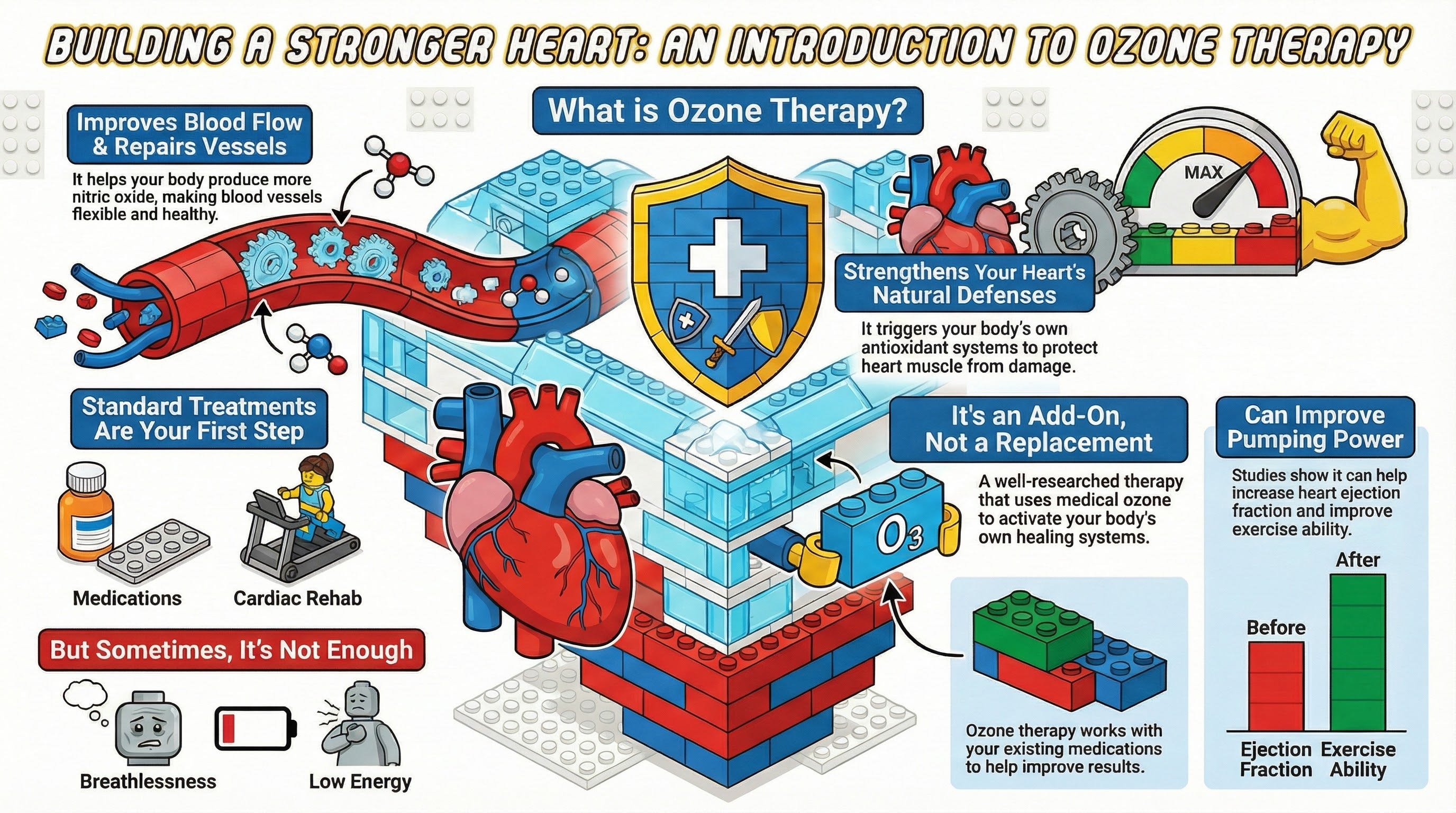
Understanding why ozone therapy affects the heart helps explain its potential:
Nitric oxide enhancement: Ozone upregulates endothelial nitric oxide synthase (eNOS), increasing nitric oxide production. NO is the molecule that keeps blood vessels flexible, reduces blood pressure, and prevents clots.
Endothelial progenitor cell mobilization: These circulating cells repair damaged blood vessel linings. Ozone therapy appears to increase their numbers and activity.
Redox balance: Rather than simply adding antioxidants (which have largely failed in cardiac trials), ozone triggers the body’s own antioxidant systems—including glutathione, superoxide dismutase, and catalase.
Microcirculation improvement: Even when large coronary arteries are open, the tiny vessels feeding heart muscle can remain dysfunctional. Ozone improves microvascular perfusion.
The Adjuvant Approach: Adding, Not Replacing
Let me be direct: ozone therapy is not a replacement for evidence-based cardiac care. The research consistently positions it as an adjuvant—something added to standard therapy to enhance outcomes.
If you have heart failure, you still need your ACE inhibitor, your beta-blocker, your diuretic. If you’ve had a heart attack, you still need your aspirin, your statin, your cardiac rehabilitation.
But when those interventions have done what they can do and you’re still not where you want to be, the question becomes: what else is available?
Protocol Considerations
The studies showing cardiac benefits have used two primary delivery methods:
Major autohemotherapy (MAH): A small amount of blood is drawn, mixed with medical-grade ozone, and reinfused. This is the most studied method for cardiovascular applications.
Rectal insufflation: Ozone gas is administered rectally, where it’s absorbed into the portal circulation. This was the method used in the heart failure case series showing ejection fraction improvements.
Typical protocols involve 15-20 sessions spread over four months, with ozone concentrations carefully calibrated based on the patient’s response. This is not DIY medicine—it requires medical supervision and precise dosing.
What This Means for Patients
If you’re living with heart failure or recovering from a heart attack, here’s what I’d suggest:
Don’t abandon conventional care. The foundation matters.
Ask questions. Bring this research to your cardiologist. Some will be curious; others dismissive. Both responses tell you something.
Seek qualified practitioners. Ozone therapy should be administered by physicians who understand both the therapy and cardiovascular physiology. If you're in the Palm Beach or Treasure Coast area, contact our office at LifeWell MD. If you're located elsewhere, the American Academy of Ozone Therapy (aaot.us) can help you find a qualified physician in your area.
Set realistic expectations. Not everyone will see dramatic improvements. But for patients who’ve hit a plateau with standard therapy, even modest gains in exercise tolerance or quality of life can be significant.
The Bigger Picture
We’re in an era where integrative approaches to heart disease are gaining scientific credibility. The same medical establishment that once dismissed the gut microbiome, inflammation, and lifestyle medicine is now incorporating them into cardiology guidelines.
Ozone therapy may follow a similar trajectory. The mechanistic rationale is sound. The clinical signals are encouraging. What’s needed now are larger, randomized controlled trials—and physicians willing to bridge the gap between conventional and integrative cardiology.
For my patient who couldn’t finish 18 holes? After completing a course of ozone therapy alongside his standard medications, he’s back on the course. His ejection fraction improved modestly, but more importantly, his functional capacity—his ability to live—improved substantially.
That’s the kind of outcome that matters.
Dr. Ramesh Kumar is a board-certified physician, Harvard certified Acupuncturist, member of the American Academy of Ozone Therapy and founder of LifeWell MD, offering integrative medicine, including medical ozone therapy at locations in North Palm Beach and Port St. Lucie, Florida. He combines over 30 years of conventional medical experience with advanced training in functional and integrative approaches.
References:
“Oxygen–ozone therapy for myocardial ischemic stroke and cardiovascular disorders” (2024). PMC11515079
“Insights into the use of oxygen-ozone therapy in ischemic cardiovascular physiology” (2024). PMC11257178
“Effect of ozone therapy on oxidative stress indices in chronic cardiovascular disease” (2025). ScienceDirect.