
The "10mm Error" That Collapsed an NFL Lung (And How We Avoid It)
T.J. Watt’s injury wasn't just bad luck—it was an anatomy error. Here is why elite recovery requires a physician, not just a technician.

Like many of you, I watched the news break about Pittsburgh Steelers star T.J. Watt this week. One of the most dominant athletes in the world walked into a routine recovery session and was rushed to the hospital with a pneumothorax—a partially collapsed lung.
First, as a physician, I feel empathy. An injury caused by a treatment meant to heal you is devastating. We wish him a swift recovery.
But my second reaction is frustration.
Stories like this create fear. They make patients look at a needle and see “danger” instead of “relief.” The truth is, this injury highlights a critical gap in modern sports medicine: The difference between a technician and a physician.
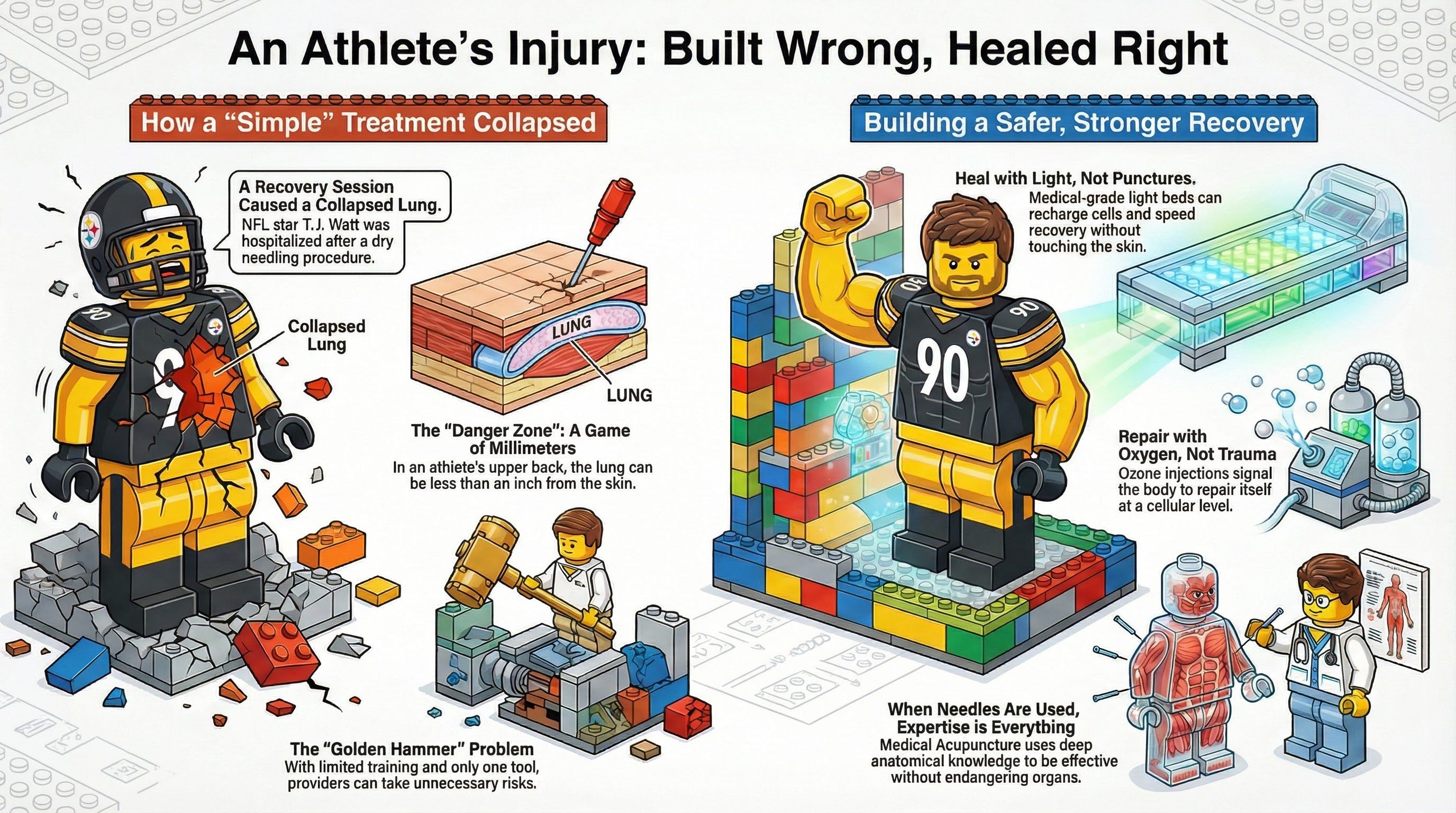
The “Game of Millimeters”
If you’ve been searching Google, you’ve probably seen scary diagrams. Let me explain what actually happened in plain English.
The human chest wall is incredibly thin. In the upper back (where athletes get tight traps and rhomboids), the pleura—the balloon that encases your lungs—can be just 10 to 20 millimeters below the skin.
If a provider has only taken a weekend certification course, they might treat every “knot” the same way. They push the needle in to find the release. But in this “Danger Zone,” if they push just a few millimeters too deep or at the wrong angle, they puncture the lung.
This is not a “side effect.” It is an error of anatomy.
[INSERT IMAGE: Upload your LEGO Infographic here] (Caption: The margin for error in standard dry needling is razor-thin.)
Why I Practice Differently
At LifeWellMD, we don’t gamble with your anatomy. As a Harvard-trained Medical Acupuncturist, I spent years in cadaver labs understanding the 3D relationships of your organs.
When I treat the thoracic cage, I use “tangential insertion”—sliding the needle across the muscle rather than plunging it down towards the lung. It makes a pneumothorax virtually impossible.
But here is the bigger secret: Sometimes, the best tool isn’t a needle at all.
The “Golden Hammer” Problem
There is a saying: “If all you have is a hammer, everything looks like a nail.” If a provider only knows dry needling, they will needle everything—even when it’s risky.
At LifeWellMD, we have a full toolkit. We don’t just “fix” what’s broken; we use medical-grade technology to heal you at the cellular level without the trauma.
The LifeWellMD Safety Protocol:
Ozone Therapy Injections: Why mechanically disrupt tissue with a needle when we can chemically signal repair? Ozone stimulates oxygen utilization and reduces inflammation safely.
NovoThor Light Bed: This isn’t a consumer gadget. It’s medical-grade photobiomodulation that treats systemic inflammation and accelerates mitochondrial recovery across your entire body.
Traumeel Injections: We use botanical, non-steroidal injections to stop pain without the tendon-weakening side effects of cortisone.
Watch the Breakdown
I created a short animation to visualize exactly how this injury happens—and why our protocols are different.
YouTube Link here : The “Hidden Risk” of Dry Needling explained.
The Bottom Line
The lesson from T.J. Watt isn’t to avoid treatment. It’s to vet your provider.
Your body is the only vehicle you get for this lifetime. You wouldn’t let a general contractor perform surgery on you. When it comes to invasive therapies, demand a physician who knows exactly where the danger lies—and how to avoid it.
Pain is inevitable. Risk is optional.
To your health,
Dr. Ramesh Kumar, MD Founder, LifeWellMD