
The Battery Crisis Inside Your Cells: Why You're Exhausted and What to Do About It
A physician's guide to mitochondrial health—the missing piece in chronic fatigue, brain fog, and accelerated aging

If you clicked through from my newsletter, you already know the basics: your body contains trillions of tiny power plants called mitochondria, and when they’re not working properly, you feel it in every aspect of your life.
But I promised you the deeper story. The science that most doctors don’t have time to explain. And more importantly—the specific strategies I use in my practice to help patients rebuild their cellular energy from the ground up.
Pour yourself some tea. This one’s worth your time.
The Scope of the Problem
Let me share something that shifted my entire approach to medicine.
After 30 years as a radiation oncologist—treating over 10,000 cancer patients—I began to see a pattern that extended far beyond oncology. Whether I was looking at cancer, heart disease, diabetes, Alzheimer’s, chronic fatigue, or even depression, the research kept pointing to the same place:
Mitochondrial dysfunction.
It’s not that damaged mitochondria cause every disease. But they show up at the scene of almost every chronic illness we face. They’re either the spark that starts the fire or the reason the fire keeps burning.
Here’s why this matters to you, even if you’re not sick:
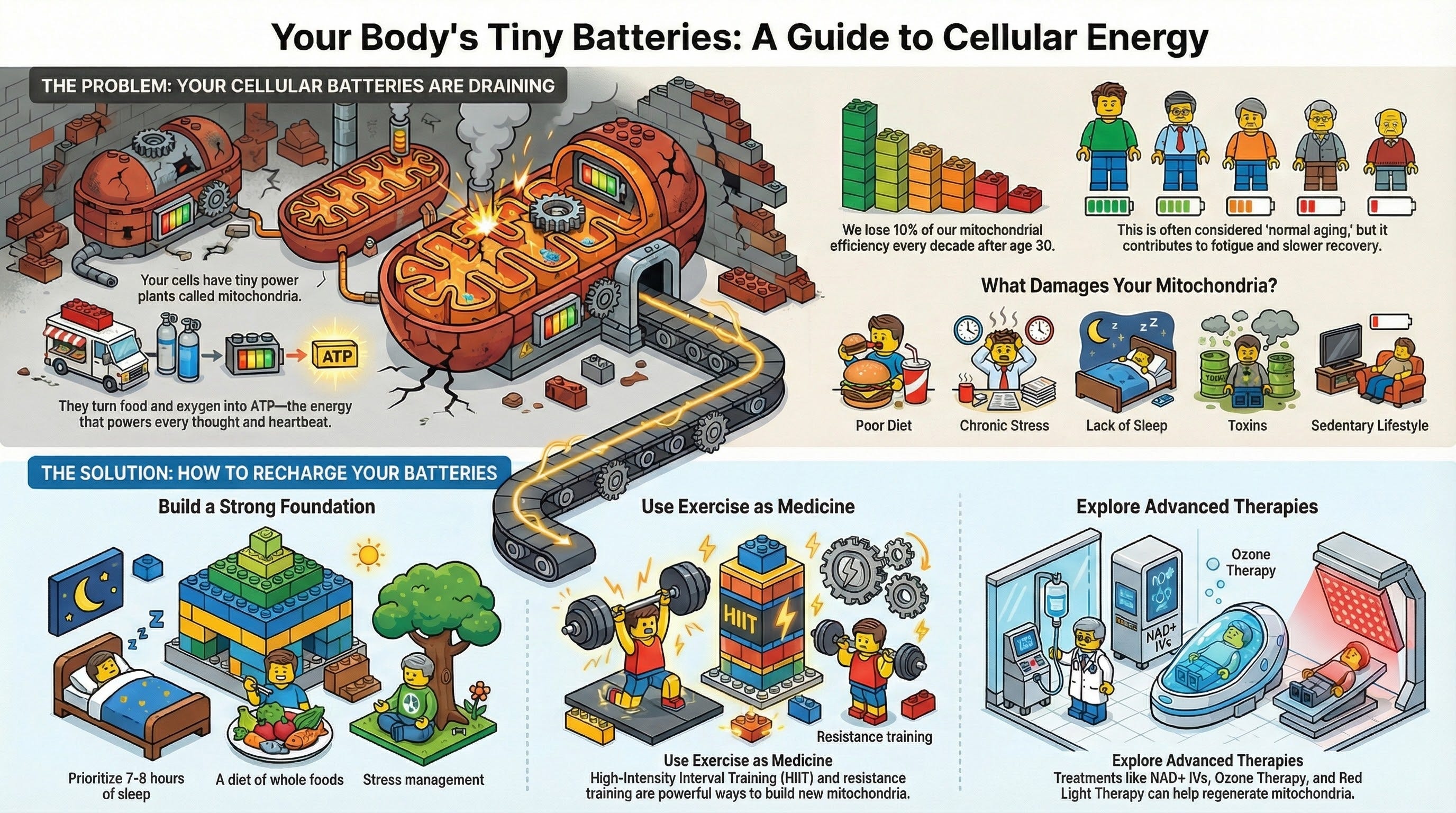
Mitochondrial function naturally declines with age. By some estimates, we lose 10% of our mitochondrial efficiency every decade after age 30. That’s not a disease. That’s supposedly “normal aging.”
But what if it doesn’t have to be?
What if the fatigue, the mental fog, the slow recovery, the creeping sense that your body just isn’t responding like it used to—what if that’s not inevitable? What if it’s a signal that your cellular batteries need attention?
This is the question that led me from conventional oncology into functional and integrative medicine. And it’s why mitochondrial health has become central to almost everything I do at LifeWell MD.
Understanding Your Cellular Power Grid
Before we talk solutions, let’s go a little deeper into the problem. Don’t worry—I’ll keep this accessible.
What Mitochondria Actually Do
Mitochondria convert the food you eat and the oxygen you breathe into a molecule called ATP (adenosine triphosphate). ATP is the energy currency of your body. Every heartbeat, every thought, every muscle contraction, every hormone produced—all of it requires ATP.
Your body produces roughly your entire body weight in ATP every single day. Read that again. If you weigh 150 pounds, your mitochondria manufacture about 150 pounds of ATP daily—it’s just recycled so rapidly you never accumulate it.
When this system works well, you have abundant energy, clear thinking, quick recovery, and resilience against stress and illness.
When it doesn’t? Everything suffers.
How Mitochondria Get Damaged
Your mitochondria are vulnerable. Here’s what degrades them:
Oxidative stress: Mitochondria produce free radicals as a byproduct of energy production. It’s like exhaust from an engine. Normally, your body neutralizes these. But when the balance tips—from toxins, poor diet, or chronic inflammation—the damage accumulates.
Chronic inflammation: Inflammatory signals directly impair mitochondrial function. This creates a vicious cycle—damaged mitochondria produce more inflammation, which damages more mitochondria.
Nutrient deficiencies: Mitochondria require specific raw materials—CoQ10, B vitamins, magnesium, iron, and critically, NAD+. Without adequate supplies, they can’t do their job.
Toxin exposure: Heavy metals, pesticides, certain medications, and environmental toxins can poison mitochondrial enzymes directly.
Chronic stress: Elevated cortisol impairs mitochondrial biogenesis—your body’s ability to make new mitochondria.
Sedentary lifestyle: Your body builds mitochondria in response to energy demand. No demand, no new mitochondria.
Poor sleep: Much of mitochondrial repair and regeneration happens during deep sleep. Chronic sleep deprivation is chronic mitochondrial neglect.
The Good News: Mitochondrial Biogenesis
Here’s where hope enters the picture.
You can grow new mitochondria. Your body has a master switch called PGC-1α (don’t worry about the name) that, when activated, triggers the production of fresh, healthy mitochondria.
Even better—you can stimulate this switch through specific interventions. Some are lifestyle-based. Others are therapeutic. And when you combine them strategically, the results can be profound.
Let me walk you through the approaches I use at LifeWell MD.
The LifeWell Approach to Mitochondrial Restoration
1. NAD+ Restoration
If ATP is the energy currency, NAD+ (nicotinamide adenine dinucleotide) is the machinery that produces it. Without adequate NAD+, your mitochondria simply cannot generate ATP efficiently—no matter how healthy they are otherwise.
Here’s the problem: NAD+ levels decline dramatically with age. By age 50, most people have roughly half the NAD+ they had at 20. By 80, it may be as low as 1-10% of youthful levels.
This decline correlates almost perfectly with the symptoms we associate with aging—fatigue, cognitive decline, metabolic dysfunction, slow recovery.
At LifeWell MD, we offer NAD+ IV therapy, which delivers this critical molecule directly into your bloodstream, bypassing the limitations of oral supplementation. Patients often describe the effect as “someone turned the lights back on.”
NAD+ doesn’t just power existing mitochondria—it activates sirtuins, a family of proteins involved in mitochondrial biogenesis and DNA repair. You’re not just refueling; you’re triggering regeneration.
2. Ozone Therapy: Controlled Oxidative Stress
This one surprises people. Didn’t I just say oxidative stress damages mitochondria?
Yes. But here’s the nuance that changes everything: brief, controlled oxidative stress triggers a profound adaptive response. It’s called hormesis—the biological principle that what doesn’t kill you makes you stronger.
When we administer medical ozone, we’re giving your body a small, controlled challenge. Your cells respond by upregulating their own antioxidant defenses—particularly the Nrf2 pathway, which activates over 200 protective genes. The result is that your mitochondria become more resilient, not less.
Think of it like exercise for your cells. The temporary stress creates lasting strength.
At LifeWell MD, we offer several forms of ozone therapy:
Ozone Saline IV Therapy: Medical-grade ozone is infused into saline solution and delivered intravenously. This allows ozone to interact with your blood, triggering systemic antioxidant and anti-inflammatory responses. Patients often report improved energy, mental clarity, and faster recovery from illness.
Ozone Sauna (HOCATT): You sit in an ozone-infused steam cabinet while your body absorbs ozone transdermally (through the skin). This combines the benefits of ozone with hyperthermia—heat stress that further stimulates mitochondrial biogenesis. The sweating also supports detoxification, removing some of the toxins that damage mitochondria in the first place.
Ozone therapy is one of the most underutilized tools in medicine. The research supporting its safety and efficacy continues to grow, and in my clinical experience, it’s been transformative for patients with chronic fatigue, autoimmune conditions, and stubborn infections.
3. Near-Infrared Light Therapy (Photobiomodulation)
This is where physics meets biology in a beautiful way.
Your mitochondria contain a molecule called cytochrome c oxidase—a key enzyme in the ATP production chain. This enzyme has a remarkable property: it absorbs light in the red and near-infrared spectrum (roughly 600-1000nm wavelength).
When near-infrared light reaches your mitochondria, it literally energizes this enzyme, accelerating ATP production. It also triggers the release of nitric oxide, which improves circulation, and activates cellular repair mechanisms.
This isn’t theory. Photobiomodulation has thousands of published studies supporting its effects on energy production, tissue healing, inflammation reduction, and even cognitive function.
At LifeWell MD, we use the NovoThor whole-body light therapy pod—a medical-grade device that bathes your entire body in therapeutic near-infrared light. Twelve minutes in the NovoThor delivers light energy to trillions of cells simultaneously.
Patients use it for:
Energy enhancement and fatigue reduction
Faster recovery from exercise or injury
Chronic pain and inflammation
Skin health and wound healing
Cognitive clarity and mood support
There’s something almost poetic about it—using light to recharge your cellular batteries. The sun has been doing this for us since the beginning of life on Earth. The NovoThor allows us to harness that principle in a controlled, therapeutic dose.
4. Grounding (Earthing): The Simplest Intervention You’re Not Doing
Of all the mitochondrial support strategies, this one costs nothing and sounds almost too simple to be true.
Grounding—also called earthing—means direct physical contact between your body and the earth. Walking barefoot on grass, sand, or soil. Sitting with your back against a tree. Swimming in natural bodies of water.
Here’s the science: The earth’s surface carries a subtle negative electrical charge, rich in free electrons. When you make direct contact, these electrons flow into your body, where they act as natural antioxidants—neutralizing the free radicals that damage mitochondria.
Research on grounding has shown:
Reduced inflammation markers
Improved blood viscosity (thinner blood, better circulation)
Normalized cortisol rhythms
Faster recovery from exercise
Improved sleep quality
All of these directly or indirectly support mitochondrial function.
The problem is that modern life has almost completely disconnected us from the earth. Rubber-soled shoes, elevated buildings, synthetic flooring—we’ve insulated ourselves from a source of healing that every previous generation took for granted.
My prescription: 20 minutes of barefoot contact with natural ground, daily if possible. It’s free. It’s pleasant. And the research suggests it may be one of the most important things you can do for your cellular health.
If you can’t get outside regularly, grounding mats and sheets are available that simulate the effect indoors.
5. Hormone Optimization
Your hormones are signaling molecules—they tell your cells what to do. And several hormones have direct effects on mitochondrial function.
Testosterone doesn’t just build muscle. It increases mitochondrial biogenesis, enhances mitochondrial respiratory function, and protects mitochondria from oxidative damage. The fatigue that often accompanies low testosterone isn’t just about motivation—it’s cellular.
Thyroid hormones are perhaps the most powerful regulators of mitochondrial activity. They directly control metabolic rate by determining how hard your mitochondria work. Even subclinical thyroid dysfunction can manifest as profound fatigue.
DHEA, often called the “mother hormone,” supports mitochondrial membrane integrity and has been shown to improve mitochondrial function in aging.
At LifeWell MD, we don’t just check if your hormones are “in range.” We optimize them for function—because the difference between the bottom of the normal range and optimal can be the difference between surviving and thriving.
6. Strategic Movement: Exercise as Mitochondrial Medicine
Exercise is the most powerful natural stimulus for mitochondrial biogenesis. When you demand more energy from your muscles, your body responds by building more power plants to meet that demand.
But here’s the nuance: more is not always better.
Excessive endurance exercise, without adequate recovery, can actually increase oxidative damage and impair mitochondrial function. The key is strategic stress followed by strategic recovery.
What works best for mitochondria:
High-intensity interval training (HIIT): Brief bursts of intense effort trigger powerful adaptive responses without the oxidative burden of prolonged exercise.
Resistance training: Builds mitochondria specifically in muscle tissue, which is metabolically active and influences whole-body energy production.
Walking: Gentle, sustained movement that improves circulation and supports mitochondrial function without excessive stress—especially after meals.
The best exercise for your mitochondria is the one you’ll actually do consistently. But if you’re looking to optimize, consider incorporating at least two sessions of high-intensity or resistance training per week, combined with daily walking.
7. The Foundation: Sleep, Nutrition, and Stress
No amount of advanced therapy can compensate for neglecting the basics.
Sleep: Mitochondrial repair and biogenesis occur primarily during deep sleep. Seven to eight hours is non-negotiable. If you’re struggling with sleep, this must be addressed before anything else.
Nutrition: Your mitochondria need raw materials—B vitamins, CoQ10, magnesium, omega-3 fatty acids, and quality protein. A diet rich in colorful vegetables, healthy fats, and clean protein provides the building blocks. Processed foods, excess sugar, and industrial seed oils actively harm mitochondrial function.
Stress management: Chronic stress elevates cortisol, which directly inhibits mitochondrial biogenesis. Whatever practice works for you—meditation, prayer, time in nature, breathwork, acupuncture—building stress resilience is mitochondrial medicine.
Putting It All Together: The LifeWell Protocol
When a patient comes to me with fatigue, brain fog, or that vague sense that their body just isn’t working right, here’s how I think about it:
First, we identify and remove what’s damaging mitochondria—toxins, chronic infections, inflammatory foods, sleep deprivation, unmanaged stress.
Second, we provide the raw materials mitochondria need—through nutrition, targeted supplementation, and when indicated, NAD+ IV therapy.
Third, we stimulate mitochondrial biogenesis—through strategic exercise, ozone therapy, near-infrared light, and hormone optimization.
Fourth, we support the body’s natural rhythms—sleep, circadian alignment, grounding, and stress resilience practices.
This isn’t a one-size-fits-all protocol. Each patient gets an individualized approach based on their unique physiology, history, and goals. But the framework is consistent: stop the damage, provide the fuel, stimulate regeneration, support the rhythm.
The Deeper Truth
I want to leave you with something beyond the science.
After 30 years of practicing medicine—first fighting cancer with radiation, now supporting healing through integrative approaches—I’ve come to believe that energy is not just physical. The vitality we seek has dimensions that extend beyond ATP and mitochondria.
There’s a reason every ancient tradition spoke of life force—Qi in Chinese medicine, Prana in Ayurveda, Ruach in Hebrew, Pneuma in Greek. They understood something we’re only now rediscovering in our laboratories.
When we support our mitochondria, we’re not just optimizing biochemistry. We’re tending to the fire that animates us. We’re honoring the fundamental gift of being alive.
That’s why I do this work. Not just to help people feel less tired—but to help them feel fully alive.
Your Next Step
If this resonates with you—if you’ve been running on 15% and you’re ready to find out why—I invite you to take action.
Option 1: Schedule a Mitochondrial Health Evaluation We’ll assess your current cellular energy status through advanced testing and create a personalized restoration plan.
Option 2: Experience the NovoThor If you’re curious about near-infrared light therapy, we offer introductory sessions so you can feel the difference for yourself.
Option 3: Explore NAD+ or Ozone Therapy For those ready to dive in, we can discuss which approach makes most sense for your situation.
Schedule Your Consultation by calling Dr. Kumar at (561) 210-9999
To your health—and your light,
Dr. Ramesh Kumar, MD Board-Certified Radiation Oncologist | Harvard-Trained Medical Acupuncturist | Functional Medicine Guru. LifeWell MD — Port St. Lucie & North Palm Beach
P.S. If you found value in this deep dive, I’d be honored if you shared it with someone who needs to hear it. That friend who’s always exhausted. That family member who’s been told “your labs are normal” but knows something isn’t right. Sometimes the right information at the right time changes everything.
Share This Article With Your Loved Ones Please.