
Why “Normal Labs” Aren’t Enough: A Different Path Forward in 2026
This year, stop settling for “fine.” Here’s how to actually feel like yourself again.

There’s a moment that happens in doctor’s offices every day.
You sit across from your physician, exhausted, aching, feeling decades older than your years. They glance at your bloodwork, look up, and deliver the verdict:
“Everything looks normal. You’re fine.”
But you’re not fine. You know your body. Something is off—has been off—and a number on a lab report doesn’t change what you feel when you wake up each morning.
If this describes your experience, I want you to know: the problem isn’t you. The problem is a medical system built around a single, incomplete concept.
That concept is repair. Fix what’s broken. Manage the symptom. Move on.
After thirty years as a board-certified radiation oncologist—and after treating over ten thousand patients—I’ve come to believe that repair is only the beginning. It’s necessary, but it’s not sufficient. If you want to actually thrive, not just survive, you need a fuller framework.
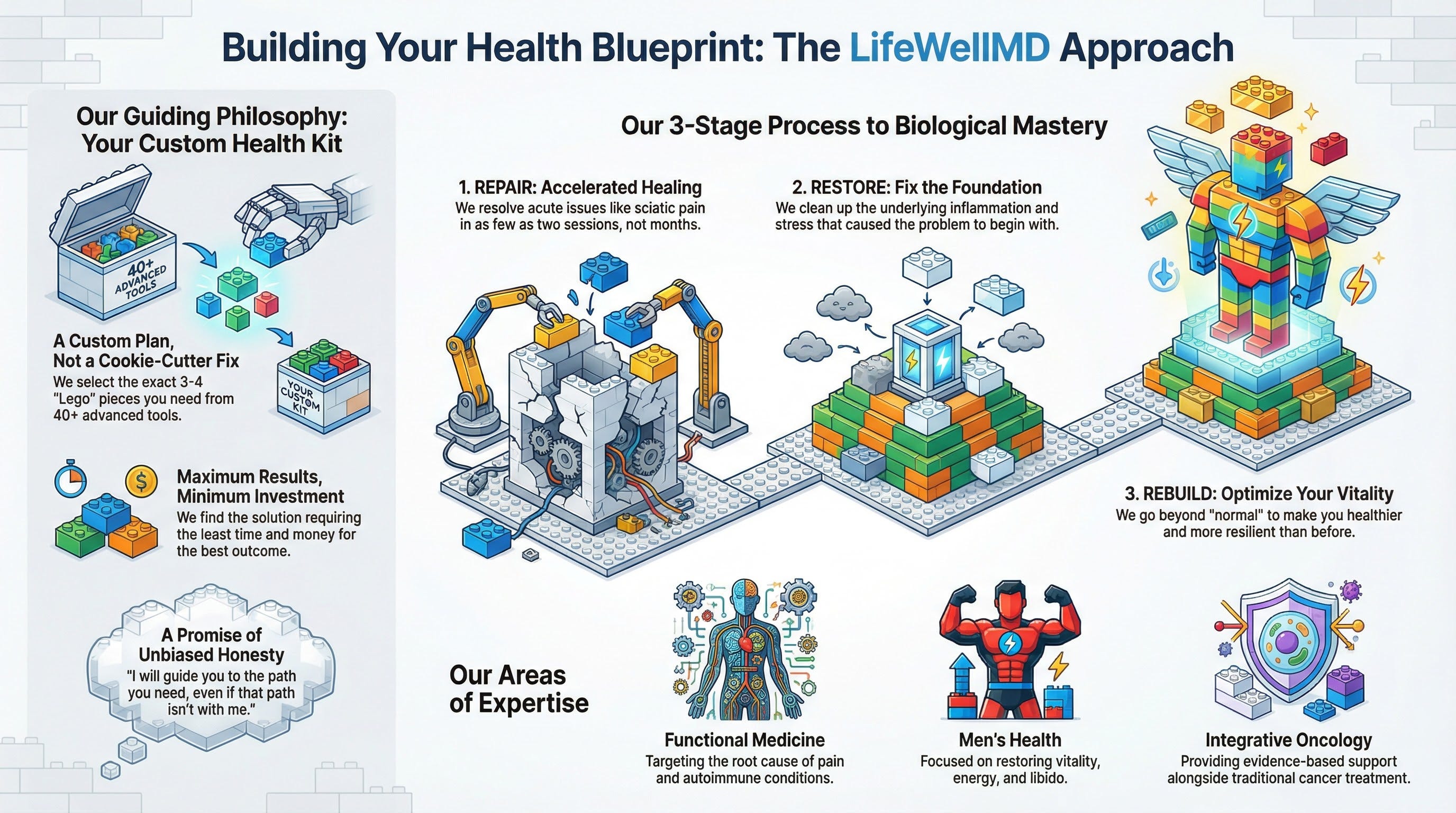
I call it Repair, Restore, Rebuild.
As we step into 2026, I want to share this framework with you—not as a sales pitch, but as a map. A way to understand where you are in your health journey and what might actually move you forward.
If you prefer to watch, here's the 2-minute version above.
Or keep reading for the full breakdown.
The Three Stages
Stage 1: Repair—Resolving What’s Acute
This is where conventional medicine lives, and it’s genuinely important. When something is broken—a disc pressing on a nerve, a hormone level that’s crashed, a cancer that needs treatment—you need intervention.
But here’s where I part ways with the standard approach: repair doesn’t have to be slow.
Traditional medicine often treats repair as a passive process. You get a diagnosis, a prescription, maybe a referral to physical therapy, and instructions to wait. Weeks become months.
I believe we can do better. By combining Western diagnostic precision with Eastern therapeutic approaches—I’m trained in medical acupuncture through Harvard Medical School—I can often compress timelines dramatically.
A patient comes in with severe sciatic pain. The conventional path: painkillers, imaging, weeks of PT, maybe an eventual injection. My approach: targeted intervention on day one. Two sessions later, the pain that was supposed to take months to resolve is gone.
This isn’t magic. It’s selecting the right tool for the specific problem, rather than following a generic protocol.
Stage 2: Restore—Cleaning Up the Terrain
This is the stage most doctors skip entirely.
The acute problem is resolved. The pain is gone, the lab value normalized, the immediate crisis handled. Case closed, right?
Not quite. Because the environment that created the problem often remains. The chronic inflammation. The metabolic dysfunction. The hormonal imbalance that’s been building for years.
If you don’t address the terrain, the problem comes back—or a new one emerges.
In the Restore phase, we identify and correct the underlying conditions that made you vulnerable in the first place. This might mean addressing gut health, optimizing sleep architecture, reducing inflammatory load, or rebalancing hormones that have drifted from their optimal range.
The goal isn’t just to eliminate the symptom. It’s to eliminate the cause.
Stage 3: Rebuild—Beyond Baseline
This is where we leave “standard of care” behind.
Most medical encounters aim to get you back to baseline—back to where you were before things went wrong. That’s a reasonable goal, but it’s not ambitious enough.
What if you could be better than your previous baseline? What if the health crisis that brought you in became the catalyst for functioning at a level you haven’t experienced in years?
In the Rebuild phase, we focus on optimization. Hormonal vitality. Cognitive sharpness. Physical resilience. The kind of energy and clarity you may have assumed were permanently behind you.
This isn’t about vanity or chasing some idealized version of youth. It’s about reclaiming capacity—the capacity to be present for your family, to perform in your career, to enjoy the life you’ve built.
The Lego Philosophy
I want to be direct about how I practice, because it’s probably different from what you’ve encountered.
Over the years, I’ve assembled a broad toolkit—peptide therapies, acupuncture, hormone optimization, nutritional interventions, and more. Roughly forty different modalities I can draw from.
But here’s what I never do: throw the whole toolkit at you.
Think of my practice like a set of Legos. My job isn’t to sell you all forty pieces. It’s to look at your unique situation and select the exact three or four pieces needed to build the result you want.
Two patients might come in with the same complaint—fatigue, back pain, low libido. But they’re different people with different underlying causes. One might need a Repair intervention. Another might need Restore. A third might be ready for Rebuild.
I tailor the plan to the patient. Not the patient to the plan.
Efficiency matters. I want to find the path that requires the least investment of your time and money to get the maximum result. If I can solve your problem with one intervention, I will never try to sell you five.
My Promise
This is the part where I need you to understand my heart.
Because I have a broad toolkit, I also know exactly when none of my tools are the right fit. I don’t try to grab every patient who walks through my door.
If you come to me with a problem that requires surgery, I’ll tell you immediately—and help you find the right surgeon. If your situation falls outside my scope, I’ll say so clearly and point you toward the specialist you need.
I don’t believe in upselling. I don’t believe in unnecessary treatments. I believe in doing the right thing, even when the right thing is telling you something you’d rather not hear.
Real medicine requires honesty. Sometimes the honest answer is “I can fix this in two sessions.” Sometimes it’s “You need to see someone else.” I promise to always tell you the truth, so you can find the best path forward.
A New Year, A New Beginning
If you’ve spent years feeling dismissed—if you’ve been told your labs are “normal” while your body tells you otherwise—2026 can be different.
Not because of a miracle cure or a magic supplement. But because you deserve a physician who actually listens, who takes the time to understand your unique situation, and who has the expertise to do something meaningful about it.
That’s what I offer at LifeWell MD. Whether you’re dealing with chronic pain, autoimmune issues, hormonal decline, or navigating cancer and its aftermath, I bring three decades of oncology training together with deep functional medicine expertise to see you as a whole person—not just a diagnosis.
How to Take the Next Step
If you’re local to Palm Beach or the Treasure Coast:
I see patients in person at my offices in North Palm Beach and Port St. Lucie. An initial consultation lets us review your history, examine your labs with fresh eyes, and determine exactly where you are in the Repair-Restore-Rebuild journey—and what comes next.
→ Schedule an in-office consultation
If you’re anywhere else:
I offer comprehensive telehealth consultations via Zoom. We’ll do a deep review of your situation, your labs, and your goals—and design a custom protocol that fits your life and your budget.
→ Schedule a telehealth consultation
Here’s to 2026. Here’s to finally feeling like yourself again.
— Dr. Ramesh Kumar, MD Board-Certified Radiation Oncologist | Functional Medicine | Harvard-Certified Medical Acupuncturist LifeWell MD — North Palm Beach & Port St. Lucie